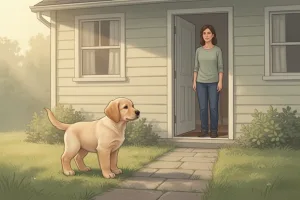
Your puppy’s first day at home needs a manageable plan, with space to settle and people who know which jobs they are doing. Prepare the home before arrival, keep the handover information together, and leave room to respond to the puppy rather than filling the day with appointments.
The worksheet below is a practical household organiser. It does not prescribe feeding quantities, fixed sleep periods or a medical waiting time. Those depend on information about your puppy that a general article cannot supply.
Collect the information you will need
Dogs Trust’s first-day advice recommends finding out the puppy’s existing food and feeding schedule, preparing a quiet bed, puppy-proofing the home, and letting the puppy explore at their own pace. It suggests introducing rooms gradually and keeping early plans modest.
Use those principles to prepare a handover sheet. Before collection, write down the questions you still need answered. Keep the actual answers separate from your own planned arrangements so nobody mistakes a guess for information supplied by the previous carer.
- Food: Record the food currently used and the instructions provided.
- Records: Keep veterinary and other handover documents together.
- Contacts: Save the previous carer’s contact details and your chosen veterinary practice’s contact information.
- Unknowns: List anything you still need to clarify instead of filling in a default from the internet.
A shared folder, envelope or phone note can work. The useful feature is that everyone involved knows where it is. For example, if one person collects the puppy and another prepares food, the feeding information should be available to both.
Walk through the home before arrival
Dogs Trust highlights moving reachable belongings and dangerous items, including wires and sharp objects. Its guidance also describes using baby gates to limit access where needed. Treat that as a prompt to inspect your actual rooms, rather than as a complete inventory of every possible hazard.
For a practical walkthrough, divide a sheet into “ready”, “needs attention” and “ask for advice”. Record the area, the issue and who will deal with it. An unresolved item should stay visible on the sheet; crossing everything off merely because collection time is approaching defeats the purpose.
| Area | Planning question |
|---|---|
| Arrival room | Which room will you introduce first, and what still needs moving? |
| Resting place | Where is the bed, and can household members leave the puppy undisturbed there? |
| Toilet access | Who will accompany the puppy, and which route will they use? |
| Shared entrance | Who will manage visitors, deliveries and open doors? |
These are organising questions, not a claim that a particular room layout suits every puppy. A flat with a communal entrance and a house with a private garden will have different answers. Adapt the checklist to the home you actually have.
Give people jobs, not the puppy a packed timetable
One possible arrangement is to have one adult deal with handover information while another keeps the arrival room ready. Later, they can swap. In a one-person household, the same worksheet can serve as a reminder of what is prepared and what can wait.
Keep optional activities separate from essentials. Photographing the arrival, inviting friends and introducing every room need not all happen at once. The point of the plan is to reduce conflicting household expectations, not to produce a perfect first-day schedule.
Dogs Trust advises giving the puppy space when they retreat to their bed, offering regular toilet opportunities and rewarding outdoor toileting after it is finished. It also advises against punishment for accidents. Write down how your household will put those points into practice.
Prepare for questions and unexpected problems
Keep a short factual note of anything you want help with: what you observed, when it happened and any relevant handover information. If you are concerned about eating, drinking, toileting or health, contact your vet for advice rather than relying on a generic “wait a day” rule.
For behaviour questions, Dogs Trust’s puppy behaviour guidance provides further reading and directs owners who are struggling towards professional support. This planning sheet does not diagnose separation anxiety or prescribe a behaviour treatment.
End the day with a handover
Before the household settles for the evening, identify who is responsible overnight, where the relevant supplies are, and what the next person needs to know. Note unresolved questions for the previous carer or vet. Use what you observed to revise tomorrow’s arrangements; you do not need to judge the entire transition from one day.
Related guides
- A Puppy Toilet Training Routine You Can Adapt at Home
- Positive Reinforcement Dog Training: Your First Sessions
AI-assisted editorial guide, checked against the linked sources. Illustrations are not evidence of a particular dog’s experience. For individual health or behaviour concerns, consult a vet or appropriately qualified professional.