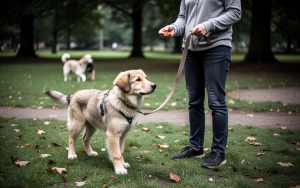
You can begin gentle lead familiarisation at home while preparing for your puppy’s first walks. That is a different decision from when they can walk on the ground in public. Ask your vet about outdoor access for your puppy’s vaccination course and local risks; there is no single birthday that makes every puppy ready for every setting.
Indoor Lead Familiarization: Building Positive Associations
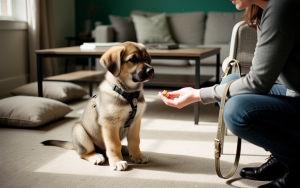
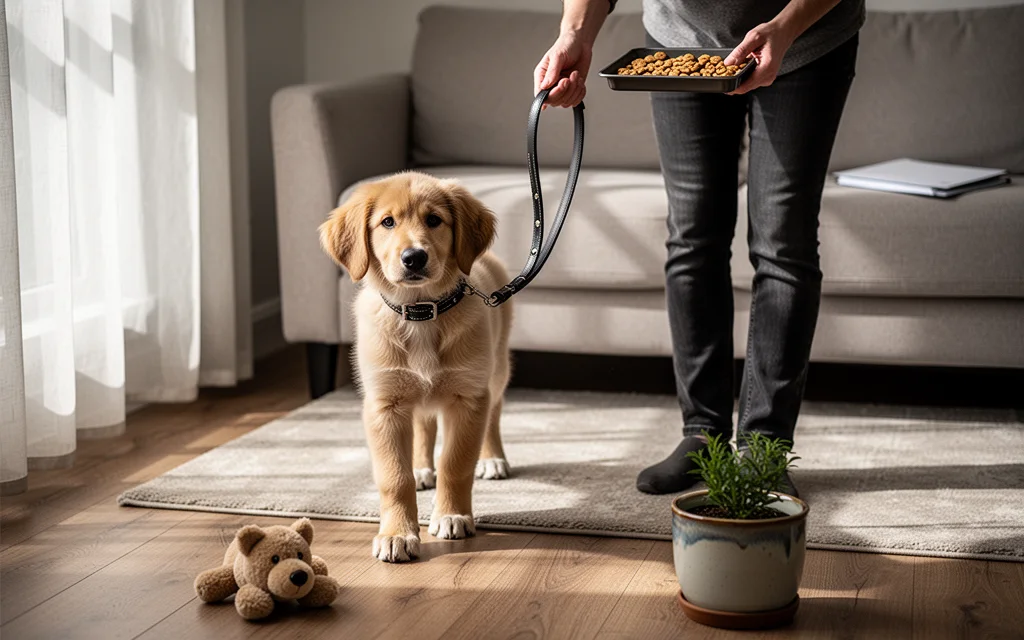
Introducing a lead indoors should focus on gradual, low-pressure interactions that help the puppy view the equipment as a neutral or positive object. Begin by letting the puppy explore the collar, harness, and lead in their own space, allowing them to sniff, touch, and investigate at their own pace. Avoid forcing contact or handling; instead, use high-value treats to create a connection between the puppy and the items. Reward calm investigation of the equipment; a lead is not a container for treats or a toy.
- Use the lead as a tool for proximity: Once the puppy is comfortable with the equipment, practice standing close to them while on the lead. Reward them for staying near you, gradually adding gentle movement (e.g., taking a step forward) and reinforcing calmness.
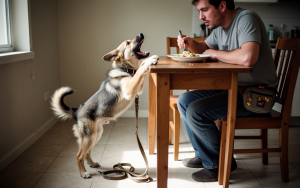
- Keep the equipment separate from toys: Use suitable toys for play and the lead for supervised walking practice. Do not attach the lead to a toy and encourage tugging on it.
- Monitor body language: If the puppy shows signs of tension (e.g., freezing, avoiding eye contact), pause and retry later. Progress should align with their comfort level, not a strict timeline.
Resources like Dogs Trust’s first-walk guide emphasize that indoor practice should prioritize the puppy’s emotional state, ensuring they feel secure rather than restricted. This approach lays the groundwork for future outdoor walks by fostering trust in the lead as a tool for exploration, not a source of anxiety.
Separate public walks from early socialisation
Dogs Trust advises checking with your vet when your puppy can begin public walks, because protection after vaccination depends on the vaccine used. Do not copy a date from another puppy’s schedule or assume that completing an injection appointment immediately makes every location suitable.
Waiting for public walks does not mean postponing all positive experiences. PDSA’s socialisation guidance discusses introducing everyday experiences during early puppyhood. Ask your vet which places and forms of contact are suitable before public ground walks, including whether and how to carry your puppy out. Keep indoor equipment practice and outdoor disease-risk decisions as separate parts of the plan.
Questions to take to your puppy’s appointment
You can use this optional checklist to organise the conversation with your vet. It is not a vaccination protocol, and it does not assume the same answer for every puppy.
- When can this puppy begin walking on public ground after their particular vaccination course?
- Which environments should we avoid for now?
- What social experiences can we arrange before public walks?
- Is there anything about this puppy’s health that changes the advice?
- If handling or fitting equipment seems uncomfortable, what should we do before trying again?
Write the answers beside the questions, including any date or condition your vet gives you. If another household member takes over training, share the answers rather than passing on a simplified rule such as “old enough now”. A plan can include comfortable indoor lead practice while still placing limits on where the puppy goes outside.
For your own training notes, record what your puppy actually practised: investigating the equipment, wearing a comfortable harness, or taking a few relaxed steps with you. That is more useful than treating age as a score. If a step is uncomfortable, return to something easier and ask for help rather than forcing progress to meet a deadline.