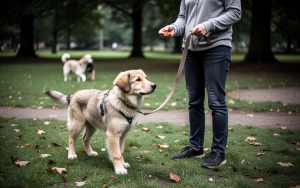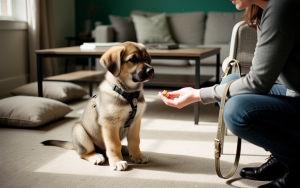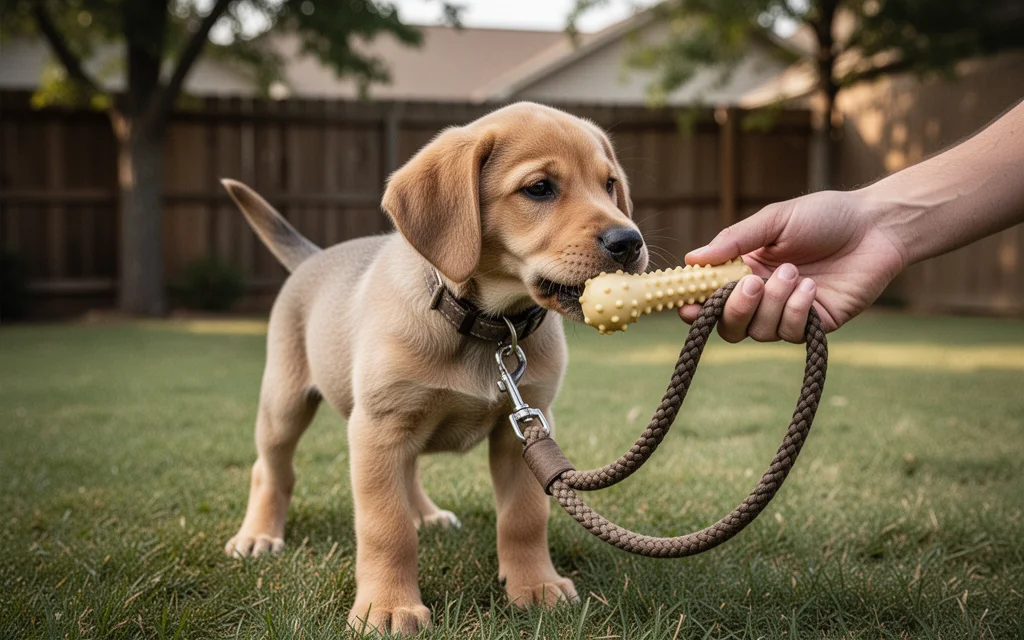
If your puppy grabs the lead during a walk, keep your handling calm and avoid tugging it back as though it were a toy. Offer an appropriate toy instead and reward comfortable walking as well as successful redirection. Check what was happening just before the grabbing began. A lead is walking equipment, not a chew toy; buying one supposedly designed for chewing does not address the difficulty your puppy is having.
Notice when the lead-grabbing starts
Dogs Trust’s lead-ragging guidance describes several possible contexts, including worry, frustration and attempts to start play. Grabbing the lead alone does not tell you which applies. Pulling forwards and biting the lead can also occur together, so do not treat them as mutually exclusive labels.
As an optional observation exercise, write down the location, what your puppy was looking at, what you were doing, and what happened next. “Grabbed the lead when I stopped to speak to a neighbour” is a useful description. “Being stubborn” is an interpretation. You could also note whether the behaviour occurred before leaving the house, near an approaching dog, or only towards the end of the walk. These are examples of things to record, not diagnoses.
Use that record to prepare a question for a trainer: “What should I change before this particular situation occurs?” It keeps the discussion focused on your actual walk rather than a generic list of reasons dogs chew. If the behaviour is escalating or you cannot manage the walk safely, get individual help.
Assessing Your Puppy’s Environment and Activity Levels
Review your puppy’s daily routine alongside what happens on walks, without assuming that activity levels explain the behaviour. Puppies, like many dogs, have a strong urge to chew, which is a normal part of their development.
Begin by evaluating your puppy’s routine. Are they receiving enough physical exercise and mental stimulation throughout the day? If walks are the only form of activity, they may not be getting the variety needed to stay engaged. According to PDSA, dogs that are left alone with nothing else to do may fill their time by chewing on things they shouldn’t. That general chewing advice does not establish why your puppy grabs the lead.
- Physical activity: Ensure your puppy has opportunities for play, running, or interactive games outside of walks. Choose activities appropriate to your puppy rather than simply making walks longer.
- Mental stimulation: Incorporate puzzle toys, training sessions, or food-dispensing toys into their daily routine. These offer alternative activities alongside walks.
- Environmental enrichment: Rotate toys and introduce new experiences to keep your puppy curious and engaged.
- Stress and anxiety: Observe your puppy’s body language during walks. Discuss concerning changes with your vet or a qualified behaviour professional rather than diagnosing stress from a single sign.
Redirecting Chewing Behavior with Alternatives
Introducing appropriate chew toys and using reward-based training can help shift a puppy’s focus from the lead to more suitable items during walks. Begin by carrying a variety of safe, durable chew toys that are specifically designed for puppies, such as rubber toys or dental chews. When your puppy starts mouthing the lead, gently redirect their attention by offering one of these toys. Do not add an unfamiliar command and expect your puppy to understand it. Dogs Trust recommends holding the toy low and also rewarding comfortable walking, so grabbing the lead does not become the only way to obtain attention or food.
Consistency is key in this process. Reward appropriate walking before lead-grabbing starts, and make the alternative activity clear when you need to redirect. This reinforces the desired behavior and helps your puppy learn what is acceptable to chew. It is also important to rotate the types of chew toys regularly to maintain your puppy’s interest and prevent boredom, which can contribute to unwanted chewing behavior.
Avoid using toys that are not recommended for puppies, such as rawhide, as they can pose a choking hazard or cause internal injuries if swallowed. Instead, choose toys that are endorsed by veterinary organizations or recommended by pet care experts. This approach not only helps manage lead-mouthing during walks but also supports long-term chew behavior training.
For more detailed guidance on selecting safe chew toys and implementing reward-based training, you can refer to the PDSA’s advice on training dogs not to chew.
Disclosure: As an Amazon Associate I earn from qualifying purchases. Links in the related-products section are paid links.
Related products
This article may be complemented by dog lead for chewing puppies.
Browse related products on Amazon
Battersea’s lead-frustration guidance recommends practising new behaviours in a quiet place before asking for them around harder distractions, building difficulty gradually and ending while the dog is still engaged. Its exercises are aimed at dogs frustrated by restricted access to other dogs or people; they are not a diagnosis for every puppy that chews a lead. Seek qualified support for extreme or persistent behaviour.